UX Designer

Teach & Learn
Make group study effective and personalized.
Design Breif
Goals
-
Enable students to internalize concepts rather than simply memorize them.
-
Transform group study into an engaging and participatory experience.
-
Apply the Feynman Method to promote critical thinking and deeper understanding.
-
Provide students with personalized learning materials that adapt to their individual study styles.
-
Integrate students’ personal interests and passions into the study process to increase motivation.
Constraints
-
The system must be usable within the context of group study, both in-person and potentially online.
-
AI support must be designed to facilitate collaboration, not replace it.
-
Learning outputs should remain clear, accessible, and simplified, avoiding unnecessary jargon.
-
The solution must be scalable to different subjects and adaptable to varying knowledge levels.
Requirements
-
Integration of Large Language Models (LLMs) to generate explanations, summaries, and study aids.
-
An interface that allows students to interact with the AI collaboratively during group sessions.
-
Support for the iterative cycle of learning: explanation, feedback, revision, and testing.
-
Tools for content personalization according to individual learning preferences.
-
Mechanisms to encourage active participation from all group members.
Understanding the problem
Students need to truly internalize the subjects they study, not just memorize them.
Studying should be a moment of discovery and personal growth, yet it is often reduced to an academic task carried out in isolation.
Group study, when done effectively, helps consolidate knowledge through comparison, dialogue, and shared perspectives. However, it often suffers from challenges:
-
Unstructured dynamics can mirror a traditional lecture, reducing engagement.
-
Different learning methods among students can cause friction.
-
Varying levels of prior knowledge can leave some participants behind.
Despite these issues, group study has great potential: it increases motivation, tests comprehension, and promotes debate that enriches learning.
Empathize
Since we are all students ourselves, the empathy phase was natural and straightforward. We conduct an internal brainstoarming session starting from the macro question: "what difficulties do we encounter in group study session?"
-
Uneven participation: some students fall behind or get distracted because they are not interested in the subject or beacuse the explanation is not presented in a stimulating way.
-
Coordination challenges: the student who takes the role of facilitator often struggles to manage time and dynamics, risking missing parts of the explanation.
-
Different learning methods: every student has their own way of studying (visual, verbal, practice-based), which can lead to misalignment.
-
Knowledge gaps: not everyone starts from the same level of understanding, which can slow down the group or discourage some members.
-
Dominance vs. silence: some voices dominate the conversation, while quieter students contribute little or nothing.
-
Focus loss: sessions sometimes drift off-topic, reducing effectiveness.
-
Lack of structure: without a clear process, group study can mirror a traditional lecture or become fragmented.
-
Motivation issues: when goals are unclear it is easy to lose interest quickly.

COLLABORATIVE STUDY SCENARIO
Stefano is a literature student at the University of Madrid, currently on Erasmus in Siena. Among the courses in his study plan he included a Social Media Marketing (SMM) course, despite not initially being convinced of the choice.
It was Karol, his Erasmus friend who was passionate about social media, who convinced him to take the course together, promising him help in preparing for the exam. Stefano dreams of becoming a professor of Spanish literature and is currently conducting research on Cervantes' early writings. However, he finds it difficult to prepare for the SMM exam since in Spain he is used to taking written exams or delivering papers, while in Siena he has to orally explain the concepts, moreover in Italian, a language with which he is unfamiliar. Together with Stefano and Karol, Marika and Rodolfo also follow the course. Marika aspires to become a product designer, while Rodolfo is an emerging singer of hip-hop music. They decide to prepare for the SMM exam together, dividing the four texts to be studied and then discussing to transfer their knowledge to the group.


However, they encounter several difficulties during the discussion sessions due to language barriers and the difficulty in clearly explaining the topics to others. Often those who listen to the explanation remain confused and fear that the information received is not sufficiently reliable and in-depth. Furthermore, having different interests, they do not know how to stimulate the interest of other comrades.
The professor introduces the group to a new service offered by the University of Siena, designed to support students in collaborative study. Curious, they decide to register. During registration, they are asked about their interests and future ambitions. Once their profiles are created, a group session is set up where they can collaborate.Marika interacts with the system for the first time and watches a tutorial video. The tutorial explains the main features, including:Uploading book PDFs.Listening to students’ explanations and reworking them.Generating study materials from these explanations (tests, flashcards, presentations).Re-explaining concepts that were not fully understood.Encouraging cooperation among the four students.Supporting and adapting explanations to each student’s interests—for example, relating concepts to music and TikTok for Rodolfo, the singer.
How might we transform group study from a passive and dispersive activity to a personalized and engaging experience?
Ideation
.jpg)
Prototype
low- fidelity prototype


high-fidelity prototype
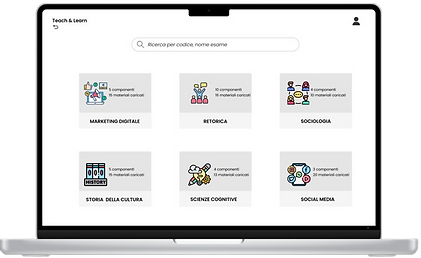
Prototyping teach & Learn I focus on clarity, accessibility, and collaborative functions such as uploading materials, generating personalized content, and organizing study sessions.To make the experience more dynamic, I integrated Voiceflow, which enabled me to prototype conversational interactions powered by AI. This integration simulated how the system could support students through natural dialogue: clarifying concepts, adapting explanations, and personalizing study materials based on individual interests. The combination of Figma and Voiceflow gave me a functional, interactive prototype that illustrated both the interface and the conversational layer of the service.
hey the video is in italian, I suggest you put on english subtitles!



Results & Take away
The prototype demonstrated the potential of Teach & Learn as a collaborative study support system, highlighting how AI can foster engagement, adapt content to different learning styles, and strengthen group dynamics.
However, one major limitation was the lack of a testing phase: without direct feedback from students, it was not possible to validate usability, identify friction points, or measure real effectiveness. A key takeaway is that future iterations should include user testing sessions to refine both the interface and the conversational experience, ensuring that the system fully responds to students’ needs.